


When Policies Collide – Untangling “Other Insurance” Clauses
At our recent London Symposium, Associate Abigail Smith discussed the potential challenges posed by other insurance clauses in insurance policies. The session covered:
- The genesis of these clauses;
- The types of other insurance clauses used to limit an insurer’s liability in the event of double insurance; and
- How competing other insurance clauses are interpreted, in practice.
What is double insurance?
Double insurance occurs when the same party is insured with two or more insurers in respect of the same interest on the same subject matter against the same risk. In other words, it occurs where an insured’s loss is covered under two or more separate policies. Whilst it can be a commercially prudent guard against insurer insolvency, it most often arises inadvertently (for example, where a composite policy overlaps with dedicated cover).
The common law position
Under common law, a policyholder that is double insured for its loss can claim against whichever policy or policies it chooses, in whichever order it chooses, subject to each policy’s limits. Then, to ensure the risk is fairly distributed between insurers, the paying insurer is entitled to claim a contribution from the non-paying insurer (a principle known as rateable contribution – Drake v Provident [2003]).
Industry challenges
Unfortunately, the common law position gives rise to some complicated issues.
The main issue is that, because there is no general rule or common law duty requiring a policyholder to disclose that it is double insured, unless an insurer asks the question directly, or notification of other insurance is a condition of the policy, a paying insurer may not be aware that they are entitled to claim a contribution.
Adding another layer of complexity, the limitation period for bringing a contribution claim is two years from the date that the right accrued under section 10(1) Limitation Act 1980. That date, which is likely to be the date of a judgment, settlement or arbitration award, is not necessarily when an insurer becomes aware that they are entitled to a contribution. In fact, with no duty to disclose, it is possible for limitation to expire without an insurer ever knowing that it had been entitled to a contribution.
Types of “other insurance” clauses
It was in recognising these challenges that the industry came up with a solution: other insurance clauses, which are standard clauses in insurance policies which limit an insurer’s liability in circumstances where another policy covers the same loss.
In The National Farmers Union Mutual Insurance Society Limited v HSBC Insurance (UK) Limited [2011], Gavin Kealey KC identified 3 main types of other insurance clauses, being:
- Escape Clauses – those that exclude cover altogether in the event that another policy covers the same loss.
- Excess Clauses – those that state that the policy will only respond in excess of any other insurance.
- Rateable Proportion Clauses – those that limit an insurer’s liability in proportion to the total cover available.
Abigail explored how each type of clause is interpreted, and how competing clauses interact, in practice.
Escape Clauses
Owing to the fact that Escape Clauses seek to exclude cover altogether in the event of double insurance, there was at the outset the potential for policyholders to be left without any cover at all where two or more policies each included an Escape Clause.
That issue was addressed in Weddell v Road Transport [1932], with the Court ruling that it would be unreasonable to leave a policyholder without any primary cover in circumstances where multiple policies were in place and multiple premiums had been paid. As such, where two or more policies include an Escape Clause, they will cancel each other out so that the policyholder can claim against whichever policy (or policies) it chooses (essentially reverting to the common law position).
Excess Clauses
The same question was more recently considered in Watford Community Housing v Athur J Gallagher Insurance Brokers Limited [2025], this time in respect of Excess Clauses. Ultimately, the Commercial Court held that, because Excess Clauses also seek to avoid primary liability in the event of other insurance, they cancel each other out in the same way that Escape Clauses do.
Escape Clause v Excess Clause
Whilst there’s no English authority addressing a scenario in which two or more policies include competing Escape and Excess Clauses, Australian caselaw does provide some assistance.
In Allianz Insurance Australia Ltd v Certain Underwriters at Lloyds of London [2019] the New South Wales Court of Appeal held that competing Escape and Excess Clauses would also cancel each other out on the basis that both seek to avoid primary liability in the event of double insurance – an Escape Clause seeks to avoid any liability, whilst an Excess Clause recognises only a secondary one.
The New Zealand courts, by contrast Abigail noted, have on one occasion reached the conclusion that an Escape Clause will prevail (albeit relying heavily on the insurance provisions in an underlying contract). As such, the outcome will always come down to the specific policy wording and the wider context; “there is no universal hierarchy that automatically applies.”
Rateable Proportion Clauses
The final type of other insurance clause limits an insurer’s share of the loss in proportion to the policy limit. For example:
- An insured incurred £900,000 of loss covered under two separate policies.
- Policy A with a limit of £1m, and Policy B with a limit of £2m.
- Policy A’s insurer would be liable for 1/3 of the loss (their £1m portion of the total £3m insured), which is £300,000, and Policy B’s insurer would be liable for 2/3 which is £600,000.
If Policy A contained a Rateable Proportion Clause, and Policy B was silent, Policy B’s insurer would have to pay the whole of the loss and then claim a contribution from Policy A’s insurer.
Rateable Proportion Clause v Escape / Excess Clause
Unlike Escape and Excess Clauses, Rateable Proportion Clauses acknowledge that an insurer does have a primary liability in the event of other insurance, albeit a limited one. For that reason, an Escape or Excess Clause will prevail over a Rateable Proportion Clause.
If Policy A included a Rateable Proportion Clause whilst Policy B included an Escape Clause, the effect of the Escape Clause is that there would be no double insurance and Policy A’s insurer would be liable for the loss without being entitled to claim a contribution from Policy B’s insurer.
Whilst there has been some controversy over how an Excess Clauses might compete with a Rateable Proportion Clause (Austin v Zurich [1944]), in NFU v HSBC, Gavin Kealey KC sought to clarify the position. He remarked that, as a matter of construction, an Excess Clause should prevail over a Rateable Proportion Clause because a Rateable Proportion Clause recognises that an insurer has a primary liability in the event of double insurance, whereas an Excess Clause does not.
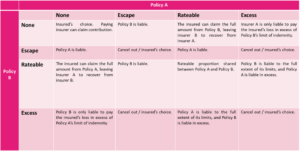
Abigail produced the table below as a starting guide for interpreting competing clauses, but was careful to note that the position will always depend on the policy wording, and the wider context.
Remaining questions
One issue that the courts are yet to address is whether, where an insured has multiple policies forming a horizontal primary layer of cover, followed by an excess layer that sits above, the entire horizontal layer must be exhausted before the excess policy responds.
The issue hasn’t arisen in caselaw to date, but Abigail remarked that it will be interesting to see how the courts approach the question when the times comes.
Key takeaways
The good news, for policyholders, is that the courts have so far refused to entertain any scenario in which an insured is left without primary cover.
That doesn’t mean, Abigail warns, that other insurance is an insurer’s problem. In circumstances where an Escape or Excess Clause prevails, an insured can be left without access to a policy that it paid a premium for, and which may well be preferable on its terms. Similarly, the disadvantage of Rateable Proportion Clauses from an insureds point of view is that the risk of insurer insolvency transfers back to the insured.
For those reasons, it is worth understanding whether there is another policy that responds to a risk and, if so, how any other insurance provisions might be interpreted.
Author
Abigail Smith, Associate


When Clauses Collide: Court of Appeal Backs MRC Over New York Arbitration
A recent Court of Appeal decision, Tyson International Company Ltd v GIC Re, India, Corporate Member Ltd [2026] EWCA Civ 40, provides valuable clarification on the approach taken by English courts when confronted with conflicting jurisdiction and arbitration provisions contained within layered reinsurance documentation.
Background:
Tyson International Company Ltd (“TICL”) is the Bermudan captive insurer for Tyson Foods, a major US‑based global food producer. In 2021, TICL arranged facultative reinsurance for its property risks with several reinsurers, including GIC Re, India, Corporate Member Ltd (“GIC”).
Two layers of facultative reinsurance were first placed on 30 June 2021 by way of a London Market Reform Contract (the “MRC”). The MRC provided for English governing law and contained a clause granting the courts of England and Wales exclusive jurisdiction over all matters relating to the reinsurance.
On 9 July 2021, this placement was supplemented by the execution of a second set of contracts in the form of the Market Uniform Reinsurance Agreement (the “Certificate”). The Certificate, instead, required disputes to be resolved by arbitration in New York under New York law. They also incorporated three amendments, the second of which stated that the MRC would “take precedence over reinsurance certificate in case of confusion” (the “Confusion Clause”).
A fire at a Tyson Foods facility in Hanceville, Alabama on 30 July 2021 gave rise to a claim under the captive policy. TICL accepted coverage and notified GIC. GIC later purported to rescind its reinsurance participation based on alleged misrepresentation relating to property valuations. TICL commenced proceedings in England relying on the jurisdiction clause in the MRC, while GIC sought to compel New York arbitration under the Certificate.
At first instance, the Commercial Court granted TICL a permanent anti‑suit injunction restraining GIC from pursuing the New York arbitration. In response, GIC appealed to the Court of Appeal.
Parties’ positions and key issues:
GIC’s principal argument was that the Confusion Clause was narrow in scope and applied only to internal drafting inconsistencies within the Certificate itself. GIC also maintained that, even if the clause applied more broadly, the English jurisdiction clause in the MRC and the New York arbitration clause in the Certificate should be read together in a manner that gave effect to both, with the English courts assuming a supervisory role over arbitration in New York.
TICL submitted that the Confusion Clause operated as a genuine hierarchy provision intended to resolve inconsistencies between the two documents. Once invoked, it required the English governing law and exclusive jurisdiction provisions in the MRC to prevail, leaving no room for the New York arbitration clause to operate.
Hence, the key issues for consideration were:
- The proper construction of the Confusion Clause; and
- Whether the English jurisdiction clause in the MRC and the New York arbitration clause in the Certificate could operate together
Analysis:
- The proper construction of the Confusion Clause:
GIC submitted that the Confusion Clause applied only where the Certificate itself contained internal inconsistencies and did not extend to conflicts between the Certificate and the MRC. The Court rejected this interpretation. It held that the natural and commercially coherent meaning of the wording was that it addressed inconsistency arising between the two documents. The MRC and Certificate were executed nine days apart and contained materially different provisions; it was, thus, far more plausible that the clause was intended to identify the document that should prevail where such differences arose.
Critically, the Court also commented that GIC’s narrow construction would be commercially unsound in rendering the clause ineffective when the most obvious form of “confusion” occurred; namely, a contradiction between the documents themselves.
- Whether the English jurisdiction clause and New York arbitration clause could operate together?
GIC argued that even if the MRC prevailed, the English jurisdiction clause could be read as supervisory or auxiliary to New York arbitration. The Court, however, rejected this in finding that the MRC conferred exclusive jurisdiction on the English courts in clear and unqualified terms, while the Certificates mandated binding arbitration in New York. To reinterpret the English clause as merely supervisory would invert the contractual hierarchy expressly agreed through the Confusion Clause and substantially distort the meaning of the exclusive jurisdiction provision.
The permanent anti‑suit injunction was, therefore, correctly granted.
Conclusion:
The decision provides clear confirmation that ordinary principles of contractual interpretation remain paramount in resolving disputes arising from inconsistent reinsurance documentation. The Court emphasised that where parties have chosen express language, particularly as to precedence, the courts will give effect to that language according to its natural and literal meaning. It is not the role of the court to retrospectively correct what may, in hindsight, be commercially disadvantageous to one party, nor to remodel the parties’ bargain by reading fundamentally inconsistent clauses together.
Authors
Michael Robin, Partner
Pawinder Manak, Trainee Solicitor


Motor Finance and the FCA Redress Scheme: Insurance Coverage implications for policyholders
Background and Supreme Court Decision
The UK Supreme Court’s judgment in Hopcraft v Close Brothers Ltd, together with Johnson & Wrench v FirstRand Bank Limited [2025] UKSC 33, clarified the law on secret commissions in motor finance. The Court held that car dealers arranging finance do not owe fiduciary duties to customers, which removed the foundation for claims based on breach of fiduciary duty. It also confirmed that English law does not recognise a free‑standing tort of “bribery” or secret commission absent a fiduciary relationship.
However, the Court significantly tightened the standard for commission disclosure. It held that a statement that “a commission may be paid” is inadequate: lenders and brokers must disclose both the fact and the amount, or the basis, of any commission prior to the finance agreement being signed. The Court reaffirmed that undisclosed or partially undisclosed commissions can render a lender–borrower relationship “unfair” under section 140A of the Consumer Credit Act 1974.
In Johnson, the Court found an unfair relationship where an entirely undisclosed commission – approximately 55% of the total loan– created a misleading impression and contributed to the unfairness. This was held to be sufficiently opaque and extreme to create an unfair relationship, leading to an order that the lender refund the commission together with interest. In the other joined cases, however, the commission arrangements were either less substantial or subject to some level of disclosure, and the borrowers did not obtain relief. The Court also held that lenders can only be liable as accessories to a dealer’s misconduct if they acted dishonestly, which was not established on the facts.
FCA Industry‑Wide Redress Scheme
In response to the judgment, the FCA announced an industry redress scheme under s.404 FSMA, covering motor finance agreements entered from April 2007 to November 2024. The FCA has estimated that approximately 14 million agreements involved undisclosed or excessive commissions, and that around 44% (about 6.2 million loans) may be considered unfair under the new standards.
The FCA published its consultation on the mechanics of the scheme in December 2025, with responses due in early 2026. The FCA has indicated that, subject to feedback, the final rules are expected to be issued in mid‑2026, with the redress scheme going live shortly thereafter
Compensation is expected to average £700 per loan, which implies a total payout of around £8.2 billion, with the possibility that it could reach £9–10 billion. Firms will additionally incur substantial operational expenditure, estimated at £2.8 billion, to administer the scheme. Any FCA fines for misconduct would be imposed separately and would not form part of the compensation pool.
The proposed scheme requires lenders to identify affected customers and provide compensation directly. Dealers and brokers will be expected to supply relevant information, and lenders may attempt to recover a portion of the cost from brokers via indemnity arrangements.
Application to FI Liability Policies:
Motor finance lenders and brokers will look primarily to their professional indemnity (PI) or civil liability policies, and, in certain circumstances, to D&O policies. Many of these policy wordings will be bespoke to Financial Institutions (FIs).
FI PI policies cover claims arising from wrongful acts in the insured’s provision of professional services, which is likely to include providing consumer credit and complying with regulatory disclosure obligations. Many FI PI policies define a “Claim” in broad terms, often including civil claims and regulatory proceedings that could result in an order requiring payment of compensation. An FCA-mandated redress scheme is likely to fall squarely within this definition.
Moreover, if a firm fails to make the payments required under s.404 redress scheme, the FCA can treat that failure as a breach of its rules under s.404F(7) and use the full range of its enforcement powers, including directions, financial penalties and public censure, to compel compliance, while consumers also have a direct right of action under s.404B(1) to sue for the compensation owed. Additionally, the FCA may apply to the courts under its general powers (including ss.380–382 FSMA) to obtain orders compelling a firm to remedy the breach, meaning that both the FCA and the courts ultimately can require an FI to pay compensation. Hence, any such proceedings would, likely, satisfy the definition of a “Claim” sufficient to engage the insuring clause for cover.
Notwithstanding, various coverage issues may still arise as follows.
Key Coverage Issues
Issue 1: Whether Commission Refunds Constitute an Insured “Loss”
A central coverage question is whether returning commission and interest constitutes an insured “Loss.” PI policies usually cover damages or compensation that the insured is legally liable to pay. A redress scheme under s.404 can only compensate customers where they have a private legal remedy so insureds who pay compensation should be able to demonstrate to insurers that they had a legal liability.
As regards loss, the proposed redress scheme generally seeks to restore consumers to the position they would have been in if commissions had been properly disclosed, which suggests a compensatory purpose. However, there is no causation requirement under the FCA’s proposals, in that consumers will not have to prove that they would not have entered into the loan if full disclosure had been made (although the presumption that non-disclosure caused loss is rebuttable by lenders in certain circumstances, e.g. if the consumer was deemed to be “sophisticated”).
Insurers may argue that part of the relief is restitutionary because it involves disgorging a commission that the insured (or its agent) earned. Many PI policies exclude loss consisting of the return of fees or commissions. Some policies include “carve‑backs” where commissions are linked to a wrongful act by an employee, which can restore cover. Courts and insurers often distinguish between returning an improper gain (normally uninsurable) and compensating a third party’s financial loss (insurable).
While there remains a grey area, especially under policies that expressly exclude “improper profit,” it is likely that courts will view these payments as compensatory and therefore insurable. Nonetheless, disputes may arise where policy language is particularly broad or where a settlement includes elements that resemble pure disgorgement.
Issue 2: Regulatory Fines and Penalties
Although consumer compensation would probably be covered, regulatory fines are not. FI PI policies universally exclude fines, penalties, and punitive damages, either expressly or on the basis that they are uninsurable by law. Any FCA fines imposed in parallel to the redress scheme will therefore fall outside insurance cover. Statutory interest added to customer compensation is generally considered part of the damages and is normally covered.
Issue 3: Claims‑Made Basis and Notification
FI PI policies operate on a claims-made basis, making notification a central coverage issue. Many claims will arise in 2025–2026 when consumers complain or are deemed to do so under the scheme. Policies in force at that time should respond unless exclusions for known circumstances apply.
Insurers may seek to frame a failure to disclose commission levels as a material non-disclosure. This would require an insurer to show (i) the information would have influenced a prudent insurer in setting terms, and (ii) the policyholder knew (or ought reasonably to have known) the information. Historically, however, commission setting practices in motor finance were industry‑standard, widely known, and the regulatory risk was already in the public domain due to the FCA’s 2019 work. All of that, will make it harder for insurers to say they were “unaware” of the risk, or that non‑disclosure was material in a fair‑presentation sense.
Insurers are closely examining such arguments but are aware that the hurdle is relatively high, particularly as many had opportunities during renewals to ask targeted questions and add exclusions specifically targeting motor finance commission issues, as occurred with Arch Cru and BSPS.[i]
The effectiveness of “circumstance notifications” is, therefore, critical. Notifying when the Court of Appeal judgment was issued or when the Supreme Court granted permission to appeal would have preserved cover in the corresponding policy period, but insurers may argue that any such notifications were too late and not in accordance with the policy provisions. There may be disputes over when circumstances crystallised to the point of being notifiable. English case law suggests that something more than a remote possibility of claims is required, and the Court of Appeal’s expansive judgment in relation to commission disclosure arguably met that threshold.
Issue 4: Aggregation
Given the potential number of claims, aggregation will have a major impact on available limits and deductibles. PI policies often state that a series of related or continuous acts or omissions will be treated as a single claim, or that claims arising from the same originating source are treated as a single claim.
Depending on the policy wording therefore, all instances of inadequate commission disclosure by a single lender may constitute one aggregated claim.
This approach would benefit insurers in that it would cap the insurer’s liability at a single policy limit (often £10–20 million), regardless of the scale of consumer redress.
However, it would also benefit insureds in that it would mean that only one deductible applies.
Issue 5: Allocation Issues
Where a regulatory proceeding includes both compensatory and non‑compensatory elements, policies usually require allocation between covered and uncovered parts. Although fines are excluded, defence costs for regulatory investigations are often almost fully covered because the work typically relates to the compensatory issues as well.
Further, if policies do not provide for allocation, in accordance with the principle expounded in Wayne Tank and Pump Co Ltd v Employers Liability Assurance Corp [1974] QB 57, where regulatory proceedings are proximately caused by both covered and excluded matters, insurers may argue that the exclusion will prevail to preclude cover. However, it is important to note that Wayne Tank is not in fact authority that defence costs caused by two concurrent and interdependent proximate causes will be excluded, and the actual position is likely to turn on careful analysis of the policy (and the facts, as regards the reasons defence costs were incurred).
Wider Implications for Insurers and Intermediaries
This episode has substantial implications for financial services and insurance markets. PI underwriters are likely to adopt more restrictive terms, including specific exclusions, reduced limits, and higher deductibles. There may also be increased scrutiny of other products involving commission structures, such as mortgage broking or insurance distribution.
The scale of the redress means insurers will need to increase reserves and manage potential disputes within insurance towers, especially regarding aggregation and allocation. Insurers may also look to pursue subrogated claims against brokers under indemnity agreements. Reinsurers will also be significantly affected.
The ruling and redress programme reinforces the importance of transparency in remuneration across all intermediary sectors. Insurance brokers and financial intermediaries should reassess commission disclosure practices in light of the FCA’s broader focus on consumer fairness and the new Consumer Duty. Firms that continue opaque practices may face both regulatory scrutiny and increased insurance restrictions.
Although D&O exposure will, hopefully, be limited, senior managers may also face FCA attention under the Senior Managers & Certification Regime.
Conclusion
The motor finance commission litigation and resulting FCA action create extensive compensatory liabilities for lenders. FI PI policies are likely to respond, subject to limits, aggregation, notification requirements, and exclusions for fines and proven dishonesty. Commission refunds are most likely to be treated as compensatory and therefore insurable. The case underscores the importance of transparent consumer practices, early notification under claims‑made policies, and careful review of policy wording in the context of large‑scale regulatory actions.
[i] Arch Cru was a mis‑selling scandal involving investment funds marketed as low‑risk but in fact exposed to high‑risk, illiquid assets. When the funds collapsed in 2009, the FCA established a consumer redress scheme, and although many PI insurers argued that firms had breached the duty of fair presentation by failing to flag emerging regulatory concerns, those arguments were largely unsuccessful because the issues had already been widely publicised. Insurers later introduced Arch Cru‑specific exclusions once the risks became well known.
BSPS involved unsuitable advice given to steelworkers to transfer out of the British Steel Pension Scheme into riskier personal pensions. The FCA subsequently implemented a statutory redress scheme, and PI insurers again sought to rely on fair‑presentation breaches, but these arguments similarly gained little traction because the regulatory concerns were already in the public domain by the time many policies renewed. Insurers ultimately responded by adopting BSPS‑specific exclusions as the scale of the issue became apparent.
Authors
Chris Ives, Partner (Head of Financial Institutions)
Jonathan Corman, Partner
Pawinder Manak, Trainee Solicitor

A Vivid Reminder: Fire Safety Defects Can Trigger Cover
Ten years on from Grenfell, fire safety defects remain one of the defining issues in the built environment. Against that backdrop, the recent decision in Vivid Housing Ltd v Allianz Global Corporate & Specialty SE [2025] offers important guidance on how the courts approach ‘imminent damage’ and reinforces the need for insurers to be part of the solution rather than an obstacle to remediation.
At Fenchurch Law, we have advised on several imminent danger cases, an example being Nova House, Slough – which involved a variety of fire safety and structural issues. The decision in Vivid, which involved an application for summary judgment, sits squarely within this developing line of authority and offers policyholders helpful clarity.
The Policy
The operative clause at the heart of this application is Clause 3(a), which states:
Clause 3(a) Operative Clause
"The Insurers agree to indemnify the Insured against the cost of repairing, replacing and/or strengthening the Premises following and consequent upon a Defect which becomes manifest and is notified to Insurers during the Period of Insurance and not excluded herein causing any of the following events:
(i) destruction of the Premises; or
(ii) physical damage to the Premises; or
(iii) the threat of imminent destruction or physical damage to the Premises which requires immediate remedial measures for the prevention of destruction or physical damage within the Period of Insurance."
The Dispute
Vivid submitted a claim in May 2019, contending that several building safety defects had manifested at the Property, and that they all fell within the Policy's definition of "Defect", thereby triggering the Operative Clause. Allianz denied that contention.
The summary judgment application focused solely on the meaning and scope of sub-clause(iii):
"the threat of imminent destruction or physical damage to the Premises which requires immediate remedial measures for the prevention of destruction or physical damage within the Period of Insurance."
The key question here, assuming that there were such “Defects”, was whether there was a risk of imminent damage.
The Defects
- Defect 1 (Rockpanel cladding): Vivid alleged that combustible RP cladding and foam insulation were used on a building over 18m high without proper testing or barriers. It also said that combustible debris in cavities could enable fire and smoke to spread externally.
- Defect 2 (vertical cavity barriers): Vivid contended that required vertical cavity barriers were missing, allowing fire or smoke to spread unnoticed throughout the building.
- Defect 3 (horizontal cavity barriers): Vivid claimed that missing or faulty cavity barriers at party walls, slab edges, and window openings could allow fire and smoke to spread undetected throughout the development.
- Defect 4 (Rockclad bracketry): Vivid states that RP cladding panels were not properly secured to vertical rails, with brackets that were inadequately supported or overstressed, posing a risk of detachment or damage.
- Defect 5 (building debris): Vivid claimed that debris left in building cavities created a fire hazard, facilitated fire spread, and enabled water to enter flats, causing further damage.
Allianz’s Position
Allianz argued that “imminent” required a serious and immediate likelihood of damage occurring soon, which it said was not the case as of August 2019.
In their view, the clause did not cover threats that would materialise only if a non-imminent event occurred, nor extend to circumstances where remedial measures are not immediately necessary to prevent destruction or damage within the policy period.
There was no likelihood of damage occurring soon as at August 2019, Allianz said, because:
(i) Vivid’s response in the notification to whether urgent repairs were required was “N/A.”
(ii) The only measures implemented during the policy period were “Waking Watch” arrangements, which were not intended to prevent property damage.
(iii) No damage occurred during the policy period, despite the absence of remedial works.
Vivid’s Position
Vivid, by contrast, contended that “imminent damage” should be assessed objectively, and that there was no requirement that the destruction or physical damage should happen soon. On its proper construction, they said that sub-clause (iii) applied where a reasonable observer would conclude that there was a realistic prospect of physical damage requiring immediate remedial measures to prevent it.
As to each of the defects, Vivid argued that:
(i) Defects 1, 2, 3 and 5 made the development vulnerable to physical damage in the event of fire, giving rise to a realistic prospect that imminent physical damage might occur. That risk was constant given the frequency of fires, supported by evidence of similar incidents.
(ii) Defect 4 put the cladding panels and bracketry at risk of deformation and detachment, giving rise to a realistic prospect that imminent physical damage might occur.
The Court’s Decision
The Court considered whether the defects created a threat of imminent destruction or damage sufficient to engage the policy.
As to the fire safety defects, the Court held that it could not be said there was no realistic prospect of establishing a serious risk of fire and imminent damage, particularly given the implementation of Waking Watch measures, which reflected an ongoing fire concern. Put differently, the presence of a Waking Watch did not undermine the concern of a present or imminent danger. Quite the opposite, it was that very concern which required the Waking Watch to begin with.
The court emphasised that the policy required not only an imminent threat but also that immediate remedial works are necessary to prevent destruction or damage within the period of cover. Whether this threshold is met is fact-sensitive; typically, imminent threats necessitate immediate repair or mitigation. Temporary measures such as Waking Watch do not negate the need for remedial works.
Ultimately, the court concluded:
"Vivid’s case on the construction of the policy clause and whether the policy responds has a real prospect of success in relation to all Defects other than Defect 4, and the application for summary judgment is refused."
In respect of Defect 4 (Rockclad bracketry), which was unrelated to fire risk, the Court found in Allianz’s favour and granted summary judgment.
For Defects 1, 2, 3 and 5, the Court accepted that the fire‑related risks created a realistic prospect of imminent damage.
ANALYSIS
Why Did the Court Exclude Defect 4?
Defect 4 involved the risk of deformation and detachment of cladding panels and bracketry. Intuitively, one might say this creates a clear risk of physical damage. However, the court held that the defect did not amount to a fire‑related risk and did not require “immediate remedial measures” to avoid destruction or damage within the policy period.
Two nuanced reasons are at play:
- Immediacy: the deformation risk was progressive, not acute.
- Requirement for immediate works: unlike fire safety defects, the defect did not necessitate urgent intervention to avoid catastrophic loss.
This highlights a key theme in imminent danger cases: the immediacy of required remedial work often drives the outcome more than the nature of the defect itself.
Why Vivid Matters
Similar wording has been scrutinised before, most notably in Manchikalapati & others v Zurich Insurance plc & others [2019] (“Zagora”), and the court’s approach in Vivid aligns with and develops that earlier guidance.
In Zagora, the court held that imminence requires a real and present risk, not a remote or hypothetical possibility. Vivid adopts that framework but clarifies how it applies to fire safety defects, emphasising:
- fire events are inherently unpredictable;
- where fire‑related defects exist, the risk of damage is constant; and
- temporary measures (e.g., Waking Watch) do not remove the underlying risk.
CONCLUSION
The decision in Vivid is consistent with previous case law and provides helpful confirmation that:
- Fire safety defects can constitute imminent danger;
- Temporary measures such as Waking Watch do not exclude immediacy;
- The courts will continue to apply the principles developed in Zagora; and
- Insurers must recognise their role in enabling, rather than hindering, fire safety remediation.
For policyholders, the judgment offers helpful reassurance. For insurers, it is a reminder that narrow constructions of imminent danger are increasingly difficult to sustain.
Importantly, policyholders should not be required to wait for an actual fire incident before their insurance coverage becomes applicable. The judgment clarifies that waiting for harm to occur before responding to the risk is both unreasonable and contrary to the purpose of fire safety provisions.
Chloe Franklin is an Associate at Fenchurch Law


New Guidance on the Scope of RCOs: The Upper Tribunal’s Judgment in Edgewater (Stevenage) Limited and Others v Grey GR Limited Partnership
Last week, the Upper Tribunal (Lands Chamber) (“UT”) handed down its judgment in a highly-anticipated appeal against a swathe of Remediation Contribution Orders (“RCOs”), providing further guidance on the scope of section 124 of the Building Safety Act 2022 (“BSA”).
In dismissing the appeal on all grounds, Mr Justice Edwin Johnson confirmed that:
- The First-tier Tribunal (“FTT”) have jurisdiction to make RCOs against multiple parties on a joint and several basis, provided that it is just and equitable to do so (which, he was careful to note, will be a “very fact sensitive exercise”);
- The factors which the FTT may take into account when considering whether it is just and equitable to make the order under section 124(1) of the BSA are “very wide” and are not capable of exhaustion;
- Whilst the initial burden is on the applicant to put forward a case as to why it is just and equitable to award an RCO, the evidential burden is ultimately shared between the parties;
- Reference to a building safety risk in section 120(5) of the BSA is a reference to “any risk” which satisfies the conditions of the BSA, and is not a reference to risks above a particular level; and
- The question of whether remedial costs are reasonable will depend on a number of factors, including any reliance on expert reports as to the scope of the works and the time pressure that stakeholders are under to remediate continuing risks to residents.
We highlight our key takeaways for those operating in the construction and property sectors below.
Background to the appeal
The appeal relates to the development of Vista Tower, a residential high-rise building in Stevenage, the freehold of which was sold to the Respondent, Grey GR Limited Partnership (“Grey”) in 2018.
Soon after, post-Grenfell investigations led to the discovery of significant fire safety defects in the building’s external walls and a Remediation Order was issued requiring Grey to remedy those defects by 9 September 2025.
On 24 January 2025, Grey was granted RCOs against 76 corporate entities associated with the developer, Edgewater (Stevenage) Limited (the “Appellants”). Controversially, those RCOs declared each of the 76 Appellants jointly and severally liable for the total sum payable, which was in excess of £13 million.
The RCOs were appealed on a number of grounds.
Joint and several liability for RCOs
The first ground of appeal concerned whether the FTT had the jurisdiction to issue an RCO on a joint and several basis.
The Appellants, in arguing that it did not, relied on the fact that section 124(2) of the BSA describes an RCO as an order against “a specified body corporate or partnership” in the singular, rather than in the plural. In other words, the Appellants said that whilst it is open to the FTT to make a series of orders against different entities, it cannot impose a joint liability under the same order.
Interestingly, in parallel with the RCO application, Grey has commenced proceedings in the High Court (Technology and Construction Court), against the developer and two other Appellants, for a Building Liability Order (“BLO”) pursuant to section 130 of the BSA. Those proceedings have not yet come to trial, but the Appellants’ argument as to the scope of the wording in section 124(2) lead to an interesting analysis of the distinction between RCOs and BLOs.
The UT confirmed that section 130 has a different jurisdiction to section 124, and works in a different way. Section 130 applies where a body corporate has a liability under (a) the Defective Premises Act 1972 or section 38 of the Building Act 1984, or (b) as a result of a building safety risk, and is “fairly rigid in its operation”: the liability to which the original body is subject can be made transmissible to associated parties.
In contrast, under section 124 RCOs are “more flexible and open ended”: it is for the FTT to decide what amount should be paid, and by whom, and on what basis.
Ultimately, Mr Justice Johnson held that the Appellants’ singular interpretation of section 124(2) was too narrow, identifying no reason why it could not be read as a plural. Most significantly, however, he identified an obvious problem with enforcement where one or more respondent is impecunious:
“If one then assumes a situation, which will not be uncommon, where some of the respondents are or may be unable to pay, the applicant party or parties will be left with something resembling a colander, in terms of their ability to recover the total sum ordered to be paid.”
In that scenario, where an applicant is prevented from obtaining the necessary funds for remediation, the statutory purpose of the BSA is clearly frustrated. For that reason, the UT has held that the FTT does have the power to make joint and several RCOs, noting that it will not be the starting position in every case, and that it must carefully consider whether it is just and equitable to do so (which is likely to be a “very fact sensitive exercise”).
Notably, the Appellants also argued that their inability to seek contributions from others in FTT proceedings (pursuant to the Civil Liability (Contribution) Act 1978) was another reason why joint and several liability should not be imposed. However, the UT rejected that argument on the basis that Parliament had intended not to concern itself with the question of contribution in relation to RCOs (but presumably had done so in relation to BLOs, which are pursued via court proceedings) and, in any event, the issue of apportionment/contribution could be dealt with as part of the just and equitable analysis, where circumstances required.
The “just and equitable” test
The Appellants’ secondary position was that it was not just and equitable to grant an RCO as some of the Appellants did not participate in the development, nor profit from it.
The FTT had considered the very limited evidence provided by the Appellants in relation to their corporate structure, and had found that they were part of a “fluid, disorganised and blurred network” which, rather than being financially separate, most likely had a tendency to take from whichever company had money when it was needed by another. The Appellants’ evidence on this point did not impress the UT, with Mr Justice Johnson describing it as “incomplete and unsatisfactory”, a factor which appears to have weighed heavily on him when considering the grounds of appeal.
In rejecting the argument that it was not just or equitable for the FTT to award the RCO on a joint and several basis, Mr Justice Johnson confirmed that the FTT’s discretion is “very wide” and that, in drafting section 124(1), Parliament had chosen not to list or limit the factors to be taken into account. He remarked that, if he were to try and list the factors on which the FTT might rely, he “would be at risk of committing the basic error of attempting to re-write Section 124(1)”.
Mr Justice Johnson also highlighted that, whilst the initial burden is on an applicant to put forward its case as to why it is just and equitable to make an RCO, that burden is not to be overstated, and it is for a respondent to put its case in response.
The meaning of “building safety risk” in section 120(5) of the BSA
One area in which the UT disagreed with the FTT was the meaning of “building safety risk” under section 120(5) of the BSA.
The FTT had defined a “building safety risk” restrictively, as any risk which exceeded the “low” or tolerable category used in PAS9980 assessments. Mr Justice Johnson was careful to correct that interpretation however, advising that section 120(5) “means what it says”.
In other words, it does not refer to any particular level of risk and refers instead to any risk which is captured by the BSA. If Parliament had intended to refer to risk at a particular level, it would have done so (as it had in other parts of the legislation). As no particular level of risk had been referenced in section 120, it was not for the FTT to rewrite the BSA.
Whilst not mentioned in the judgment, that analysis is consistent with the FTT’s recent decision of 6 January 2026 in Canary Riverside Estate (LON/00BG/BSA/2024/0005 LON/00BG/BSB/2024/009) which held that “any risk” of fire spread or structural collapse, however small, is enough to constitute a building safety risk under section 120.
The reasonableness of remedial costs
Finally, the Appellants challenged the reasonableness of one aspect of the costs incurred. Namely, the removal of combustible foam insulation from cavity walls.
Expert witnesses had agreed that, from a purely technical perspective, it had been disproportionate to remove the foam altogether, and a cheaper and simpler solution would have been to leave it in place with the addition of a cavity barrier as effective fire stopping.
In considering the reasonableness of the works, the FTT had placed “significant weight” on the agreement of the experts, but had also considered other factors that may have affected the scope of the works, including the need to implement the remedial scheme quickly in order to minimise the continuing risk to residents living in unsafe conditions, and the fact that Grey’s PAS9980 report had concluded that the foam insulation was “high risk” and needed to be removed.
The Upper Tribunal held that the costs incurred in removing the insulation were reasonable on the basis that it was not for Grey to question the advice of its fire engineers. Rather, it was reasonable for Grey to have relied upon the PAS9980 report and not to have revisited it later in order to reduce the scope of works, especially considering the time pressure it was under from the Secretary of State to minimise the continuing risk to residents.
Implications
The decision reads as a salutary tale to developers and their associates: not only does the FTT have jurisdiction to award RCOs on a joint and several basis, but that jurisdiction may extend to associates who have not participated in the development, or profited from it.
Clearly, that is more likely to be the case where (a) there is a question mark over whether the developer is financially able to meet its responsibility under the RCO, or (b) where respondents fail to provide a comprehensive explanation of corporate structures, or are part of financially fluid networks that cannot easily be isolated, all of which were significant factors in the UT’s reasoning.
Whether the Courts adopt the same analysis in relation to BLOs remains to be seen, although that is a significant possibility given how other UT judgments have been upheld by the Courts (for instance, Adriatic Land 5 Ltd v Long Leaseholders at Hippersley Point [2025] EWCA Civ 856).
Authors